
Most guides on how to hire a virtual assistant start with where to find one. A marketplace, a job board, an agency, a recommendation from someone in your group chat.
Finding a VA is honestly the easy part.
The hard part arrives about three weeks later, when you're paying a capable person and you're somehow still the bottleneck. You answer their questions. You check their drafts. You quietly fix the small stuff because it's faster than explaining it again.
The work has moved. The decisions haven't.
This guide walks you through hiring your first virtual assistant in a way that avoids that trap. You'll pick the right first task, write a brief that attracts the right people, test them properly, and hand over work in a way that genuinely frees up your week.
Keep your inbox open in another tab. You're going to use it.
A quick note on what we mean: a virtual assistant (VA) here is someone you outsource work to remotely, either an independent freelancer or someone supplied through an agency. Not an employee. That distinction matters later, so hold onto it.

Why most first VA hires stall in week three (and it's rarely the VA's fault)
You've probably seen this pattern, or lived it.
An owner hires a VA to "help with admin." Week one feels great. The inbox is cleaner, a few calls get booked, some files get renamed.
By week three, the owner is spending more time managing the VA than they saved. Every second message is a "quick question." Every draft needs a tweak. They start wondering if they hired the wrong person.
Usually they didn't. They hired the right person for a job that was never actually defined.
"Admin" isn't a job. It's a bucket.
Inside it are dozens of tiny decisions you make without noticing. Which customer gets a reply today. Which meeting is worth taking. Whether that refund request counts as an exception.
You make those calls in two seconds because you have years of context. Your VA has three weeks.
So every one of those decisions comes back to you as a question. And the questions feel like the VA's weakness, when really they're a map of everything you never wrote down.
Once you see it that way, the whole hiring process changes.

You're not buying hours. You're buying decisions you'll stop making
This is the shift that makes everything else easier.
When you think "I need 10 hours a week of help," you buy hours. Then you fill those hours with whatever's annoying you that day. The VA does tasks, but the judgement behind each task still sits with you.
When you think "I want to stop deciding how to handle booking requests," you buy something far more valuable. You buy a decision that leaves your head for good.
Compare these two handovers:
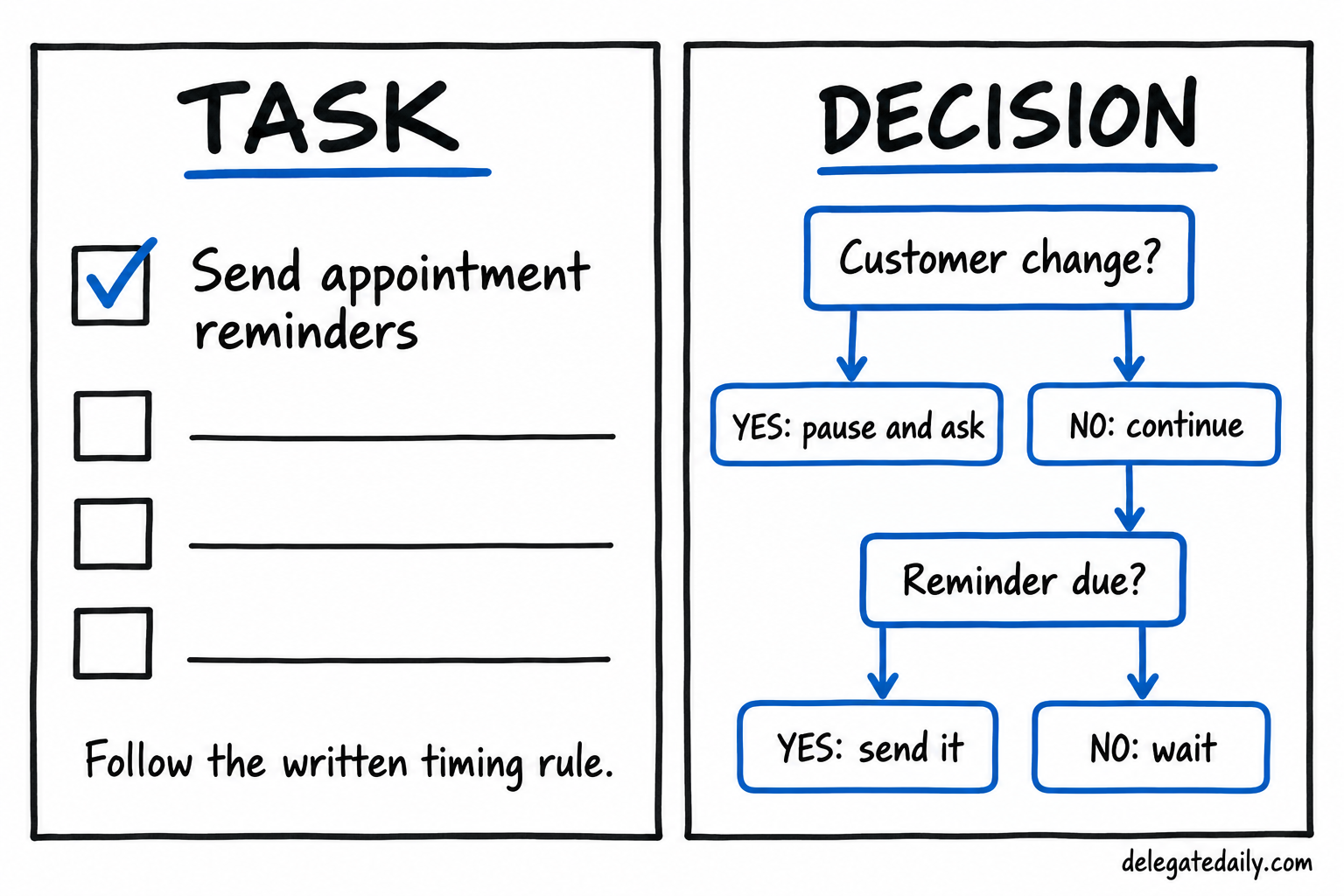
- "Can you send appointment reminders?" That's a task.
- "You own booking requests. If the slot is in my released availability and they've filled in the form, book it. If not, offer the next two options. Anything about pricing comes to me." That's a decision.
The first saves you a few minutes of clicking.
The second removes a whole category of interruptions from your life.
Every step below is built around getting you to that second version.

Start with your sent folder, not your to-do list
Your to-do list lies to you. It's full of things you'd like to do, plan to do, or feel guilty about not doing.
Your sent folder and calendar tell the truth. They show what you actually spent your time on.
Open both. Go back through one ordinary week. Not launch week, not holiday week. Just a normal one.
Write down every piece of non-core work you touched, and be specific:
- Not "email." Instead: "replied to three customers asking where their order was."
- Not "admin." Instead: "chased two suppliers for missing invoices."
- Not "calendar stuff." Instead: "moved a client call twice because of a clash."
Next to each one, write how you knew it was finished. Order question answered with a tracking link. Invoice received and filed. Call confirmed by both sides.
You'll notice two things.
First, a lot of your "busy" is the same handful of jobs repeating. That's good news. Repeating work is the easiest kind to hand over.
Second, some items have no clear finish line. "Keep an eye on the inbox" never ends. Those make dangerous first assignments, because neither of you will ever know when they're done.
The "ordinary Tuesday" test that picks your first task
Now pick one job from that list to hand over first. Not five. One, or one small cluster of closely related jobs.
Run each candidate through a quick test. Imagine an ordinary Tuesday. Your VA is doing this task while you're in back-to-back calls and can't be reached. Ask yourself:
- Does it repeat? If it only happens once a quarter, your VA won't get enough practice to get good at it.
- Can you check it without redoing it? Checking a booking takes seconds. Checking a research report might mean doing the research again.
- What's the worst realistic mistake? A clumsy internal note is fine. A refund sent to the wrong account is not.
- Could they finish most cases without you? If every single instance needs your call, you're delegating typing, not work.
The best first task scores well on all four. It repeats, it's quick to check, mistakes are recoverable, and most cases can close without you.
For lots of small businesses that ends up being something like inbox triage, booking coordination, or preparing client files before meetings. For you it might be something completely different. Trust the test, not a generic list. (Our guide to choosing the first tasks to outsource walks through a deeper version.)
One more thing before you hand anything over. Ask whether the task should exist at all.
If you're producing a weekly report nobody reads, don't pay someone to keep producing it. Kill it instead. That's the cheapest delegation there is.
Hours and availability are two different purchases (most people buy the wrong one)
This one catches almost everyone.
Say customer emails take you 30 minutes a day in total. But they drip in all day, and customers expect a reply within a couple of hours.
You don't need 30 minutes of help. You need someone keeping an eye on the inbox across the day. That's coverage, and it costs more than the raw workload suggests.
Now compare a weekly report due every Monday. It might take three hours. But nobody cares whether it gets done at 6am or 11pm, as long as it's there on Monday morning.
That's workload with a deadline. It's much cheaper to buy, and much easier for a VA in a different time zone.
Before you request a single quote, write down three things about your chosen task:
- When does work arrive? All at once, or in drips through the day?
- When must it be finished? By a fixed deadline, or within a few hours of arriving?
- When do you genuinely need to be online together? The honest answer is often "rarely."
Then ask providers to quote against that, not against "10 hours a week." You'll get prices you can actually compare, and you won't end up paying for a 9 to 5 presence you don't need. Our part-time vs full-time breakdown goes deeper on this.
Write a brief that makes the wrong people disqualify themselves
Most VA job posts are a wish list. "Email, scheduling, social media, bookkeeping, research, customer support. Must be proactive and detail-oriented."
That post attracts everyone, which means it tells you nothing. Every applicant says they're proactive and detail-oriented. Nobody writes "I'm a bit sloppy and I wait to be told things."
A good brief does the opposite. It's specific enough that the wrong people read it and think "not for me." That's exactly what you want.
Include:
- One paragraph on your business and why you need help now.
- The actual work, described as outcomes. "Every confirmed consultation has a complete client file before the call" beats "client onboarding support."
- What stays with you. "You can reschedule within my availability, but you can't offer discounts or new services." This tells good applicants you've actually thought about it.
- When work happens, based on the availability exercise above.
- What you'll teach versus what they need on day one. Your exact software? Teachable. Writing a calm, clear email to an annoyed customer? That probably needs to arrive with them.
- How you'll pay, and that there's a paid trial.
One small addition works surprisingly well. Ask applicants to answer one specific question in their application, taken from the real work. Something like:
"A customer asks to book Thursday afternoon but doesn't mention a time zone. What would you do?"
You'll learn more from three sentences of their reasoning than from any CV. We've got a full VA job description template if you want a starting point.
Where to look depends on which jobs you want to keep for yourself
People ask "where should I hire a VA?" as if there's one right answer. There isn't.
The right place depends on which parts of the hiring and managing process you're willing to do yourself. Roughly, you've got three routes.
Marketplaces and job boards. You find the person, assess them, agree terms and manage the work. Cheapest route, most work for you. Great if you've got time to screen and you like a direct relationship.
Agencies that introduce. They find candidates for you, then mostly step back. You still manage the person day to day.
Managed services. They supply the assistant plus some of the oversight: checking quality, covering absences, sometimes helping design the process. It costs more, but you're buying more than a person.
The trap is assuming the word "agency" means "managed." Some agencies do little more than match you with someone and send invoices.
So ask every provider the same blunt questions:
- Who checks the work if I'm too busy to?
- What happens to my unfinished tasks if my assistant is off sick?
- Does a replacement arrive knowing my process, or do I start from zero?
The answers tell you what you're really paying for. Our agency vs freelancer comparison has the full question list, and where to hire a virtual assistant compares the main platforms.
Ignore the portfolio for a minute and ask this one question instead
Portfolios are useful, but they hide something important. A beautiful sample doesn't tell you what the person actually did.
Maybe they designed the whole thing. Maybe they uploaded copy someone else wrote. Maybe they followed a process their last client built for them.
So in the interview, pick one example from their portfolio and ask:
"Walk me through this one. What did you get to start with, what did you do yourself, and how did you check it was right?"
Strong candidates come alive here. They tell you what was missing, what they double-checked, where they stopped and asked. Weaker candidates stay vague.
Then give them a small, realistic problem from your actual business. Not a riddle. Something like:
"A customer says I promised them a refund last month. I don't remember it. What do you do?"
You're listening for one thing above all: do they look for evidence before acting?
The candidate who says "I'd search the old emails for that promise before replying" is showing you better judgement than the one who says "I'd keep the customer happy and refund them."
Notice that the best answer often includes a question back to you. That isn't weakness. In a brand-new role, knowing when to ask is the skill. For a fuller list, see our VA interview questions guide.
Run a paid trial with a trap that isn't a trick
Never hire on the interview alone. And never give a stranger access to your live accounts to "see how they do."
Instead, run a small paid trial. Pay a fair, agreed fee whether or not you end up hiring them. Unpaid "test projects" put off good people, and some freelance platforms ban them outright.
Build the trial from invented data that mirrors your real work. Then include two kinds of case:
- An ordinary one, where the right answer is clear.
- An awkward one, where the right answer is to pause.
For a booking role, the ordinary case might be a straightforward request for a free slot. The awkward case might say "Thursday afternoon" with no time zone.
The awkward case is where the gold is. You're not trying to catch anyone out. You're checking whether they notice when the information isn't good enough to act on.
Someone who confidently books Thursday at 2pm in the wrong time zone has just shown you what they'll do with your real customers.
Someone who drafts a quick "which time zone are you in?" reply has shown you the opposite.
Be clear in advance about what you're paying, how long it should take and what you'll be looking at. Our paid trial guide has a complete example you can copy.
Sort out the paperwork before anyone touches a live customer
This part is boring. It also saves relationships.
Put these in writing before day one:
- Scope. What's included, what isn't, and how extra work gets agreed.
- Pay. Currency, rate, invoice timing, and who covers transfer fees.
- Confidentiality, and what happens to your data when you part ways.
- Who owns the work they create for you.
- How either side ends it, and with how much notice.
One warning that matters a lot. Calling someone a "contractor" doesn't automatically make them one in the eyes of tax and employment law.
If you set their hours, control exactly how they work and stop them taking other clients, the relationship can start to look more like employment, whatever the contract says. The rules differ by country, and sometimes even between tax law and employment law in the same country.
If your setup feels close to that line, get proper advice for the countries involved. Our guide on whether a VA is a contractor or employee explains what to bring to an adviser, and the VA contract guide covers what to put in writing.

Give them a key to one room, not the whole building
The fastest way to create a security problem is to send your VA your main email password "just so they can get started."
Instead, for each tool they'll use, ask one question: what's the smallest permission that lets them do this specific job?
- Give them their own login, or use the tool's built-in sharing or delegation features. Never your login.
- Keep billing, account ownership and recovery details in your name.
- If a password truly has to be shared, use a proper password manager, never a chat message.
- Turn on two-step verification everywhere you can.
Then test it together. Ask them to open the exact folder they need and do the exact action. A successful login doesn't prove they can reach what they need. It also doesn't prove they can't reach what they shouldn't.
One detail people often miss: some "delegate" permissions are far broader than they sound. Email delegation in some services lets the delegate read, send and delete messages, even if you only wanted them drafting. If the tool can't give you the boundary you want, change the workflow rather than relying on a promise. There's more in our secure access guide.
Train the exception, because the routine trains itself
Most owners train by recording a screen video of the happy path. Here's where I click, here's how I reply, done.
The VA watches it, nods, and then gets stuck on the first case that doesn't look like the video.
Routine steps are easy to learn. Anyone can copy clicks. What's hard to learn is the moment where the answer changes. That's what you actually need to teach.
So when you show them a task, narrate your thinking, not just your clicks:
"I'm checking the time zone in their email signature, because two people last month wrote 'afternoon' and meant completely different times."
Then flip it. Give them a fresh case and ask them to tell you what they'd do and why, before they do it.
This one habit catches most misunderstandings before they ever reach a customer. "Does that make sense?" almost always gets a yes. "Talk me through how you'd handle this one" gets the truth.
Every time a question comes up that your instructions didn't cover, add the answer to a shared doc. Over a few weeks that doc becomes a real operating manual, built from actual problems instead of guesses. Our guide to writing SOPs your VA can actually follow shows you how.
The quiet fixes you're not counting are eating your time saving
This is the sneakiest way a VA hire fails.
Everything looks fine on paper. Tasks get ticked off. But you're spending 20 minutes a day silently tidying their work because it's "quicker than explaining."
Those minutes vanish from your mental maths. You feel like you're saving time. You might not be.
For the first month, keep a simple log of:
- Time you spent preparing work for them.
- Time spent answering their questions.
- Time spent reviewing.
- Time spent fixing, including the quiet fixes.
Subtract that total from the time the task used to take you. That's your real saving.
Then look at why the fixes happen. If it's missing information, fix the information. If it's a rule you never explained, write it down. If it's the same clear mistake after you've explained it twice, that's a different conversation.
And watch your own habits too. If you keep rewriting perfectly acceptable work because you'd have phrased it differently, you're teaching your VA that acting on their own is risky.
They'll start asking permission for everything. And then you'll wonder why they never take initiative.
How to tell whether it's working after 30 days
At the end of the first month, sit down with your log and ask three questions:
- Do ordinary cases now close without you? Not every case. The ordinary ones.
- Do the exceptions reach you with the answer half-built? A good question sounds like "I'd move this to Thursday, but their message mentions a different time zone. Which do you want?" Not "can you check this?"
- Has your total time on this work actually dropped? Count the quiet fixes.
If it's yes to all three, expand slowly. Hand over one more related decision, test it, then review again. Don't suddenly dump your whole business on them because the first job went well.
If it's no, find the specific reason before deciding the hire failed. Missing access, unclear rules and unrealistic availability all look exactly like a "bad VA" from a distance. Our guide to measuring VA performance helps you tell them apart.
Your first-hire brief, ready to fill in tonight
Open a blank document and copy this in. It'll take you about an hour, and it's the most useful hour of the whole process.
FIRST VA BRIEF

Our business in one paragraph:

The recurring problem I need solved:

First task (one job or one tight cluster):

How I'll know it's finished:

Decisions they can make on their own:

Decisions that stay with me:

When work arrives / when it's due / when we must overlap:

Systems they'll need (and the smallest permission for each):

Budget, including my own review time:

Paid trial: one ordinary case + one awkward case:

What would make me expand, adjust or stop after 30 days:
Send this to two or three candidates or agencies and you'll get proposals you can actually compare.
More importantly, you'll know exactly what you're hiring for. That's the part most people skip, and it's the reason most first hires stall.
Finding someone is easy. Defining the job is where your time back really comes from.
Frequently asked questions
How much does it cost to hire a virtual assistant?
It varies widely by location, skill and type of service. Direct freelancers usually charge by the hour, while managed services tend to sell monthly packages that include backup and oversight. Compare quotes against the same written brief and remember to add your own review time to the real cost. Our VA cost guide shows you how.
Should my first virtual assistant be part-time or full-time?
Most small businesses should start with one well-defined responsibility. Base the decision on when work arrives and how quickly it must be handled, not just the total number of hours.
How long does it take to train a virtual assistant?
There's no fixed number. Routine cases often settle within a few weeks if your instructions are clear. Judgement calls take longer, so hand them over one at a time and test each before you remove your review. See how to train a virtual assistant.
Is a virtual assistant an employee?
In this guide, no. You're buying an outsourced service from an independent freelancer or agency. The label alone doesn't settle it legally, though. How the relationship works in practice matters, so check the rules for the countries involved.
What should I delegate to a virtual assistant first?
A task that repeats, is quick to check, has recoverable mistakes and can usually be finished without you. Common first picks are inbox triage, booking coordination and preparing client files before meetings.