
You asked someone to "look at the competition". A week later a document arrives with logos, a colour-coded grid, a few screenshots and a slide headed "Key Insights". You read it twice and realise you still cannot answer the one question you had in mind when you asked.
This article is about the opposite approach. You pick one decision, define the facts that would move it, and pay a VA to collect those facts with a link and a date against every one. A VA here means an independent service provider you engage for a defined piece of work, not someone on your payroll, which is exactly why the written brief matters so much.

Start with the decision, not the competitors
Before you name a single rival, finish this sentence: "I am about to decide whether to ______, and I will decide it by ______."
Throughout this piece I use one running example. All businesses, prices and figures below are illustrative and hypothetical. They are not real companies, not market rates, and not a survey of anything.
The owner runs a UK product photography service, mostly shooting on a per-image basis for small ecommerce brands. Quoting takes ages because every enquiry is bespoke. The owner wants to decide whether to launch a fixed ten-image ecommerce starter package at a published price.
That is a real decision with a real deadline. It immediately tells you what matters: what comparable studios publish, what is included at that price, and whether a fixed package is a normal shape of offer in that corner of the market.
Write the question down in one sentence
Convert the decision into a research question your VA can act on without interpreting your mind.
Weak version: "Research competitor pricing for product photography." Strong version: "For five UK studios selling ecommerce product photography to small online brands, record exactly what is published about price, what is included, usage rights, turnaround and any minimum order, with a source link and checked date for each fact."
It also sets a boundary that will save you from a common mistake. A published offer is evidence of what a business advertises. It is not evidence that the offer sells, that customers buy it at that price, or that it is profitable for the seller. Discounts, negotiated quotes, abandoned pages and dead products all look identical from the outside.
If competitor research is the first thing you have delegated, it is a good candidate precisely because it is bounded and checkable. It is worth reading more on choosing a bounded first assignment before you brief anything bigger.
Agree scope, time and cost before any research starts
Decide the number of competitors, the number of fields per competitor, and the deliverables. For the photography example that might be five businesses, eleven fields each, one sheet and one short memo.
Then agree a time cap and a fee, and agree what happens when the cap is reached. The useful instruction is "stop and message me with what is done and what is outstanding", not "keep going and invoice me later".
You also need rules for surprises. If a competitor publishes no pricing at all, the VA should record "not published", list the pages checked and the date, then continue with the rest of the scope. Hunting for a hidden number can burn hours and produce nothing defensible. The things that genuinely warrant pausing the work are different: a material conflict between sources, a change to the agreed list or scope, reaching the cap, or anything that would require access to non-public material.
If you have never priced this kind of work, ask the provider for an estimate against the brief rather than naming a number first. A provider who reads a tight brief and says "this is roughly six hours, here is my rate" is giving you useful information about whether the brief is clear.
Be explicit about authority too. The VA can read public pages and record what they say. They cannot sign up for trials, contact competitors, or buy a paid research tool on your behalf. Setting those edges early is part of the broader habit of defining authority and approval boundaries for anyone you work with.

Choose 3-5 comparable competitors and one relevant alternative
The instinct is to pick the biggest names or whoever ranks first. That often produces unusable comparisons, because a national brand serving enterprise clients may not be competing for the same enquiries you are chasing. It may be comparable on some dimension, but you should be able to say which one.
Pick on overlap instead. The test is whether the business serves the same buyer, solving the same problem, in the same region, for the same use case.
The US Small Business Administration's guidance on planning your business and market research frames competitor identification around your product or service and your market segment, and it explicitly includes indirect alternatives. It also draws a line between using existing research and going out to ask customers directly, which is a distinction worth holding on to here.
For the hypothetical photography business, the set might be three directly comparable studios offering ecommerce product shots to small UK brands, one studio that is slightly larger but still publishes package pricing for the same use case, and one indirect substitute.
The substitute matters. A small brand deciding how to get ten product images might not hire any studio. They might buy a lightbox kit and shoot the images themselves on a phone. That alternative can shape how a buyer weighs cost against effort and quality, and how the package has to be described, so it belongs in the sheet even though it is not a studio. It does not, on its own, tell you anything about what buyers will or will not pay.
Ask your VA to propose candidates with reasons rather than approving a list blind. You approve the final five.
Build a source-linked sheet with one fact per row
The structural decision that makes an evidence log usable is this: one fact per row rather than one competitor per row.
Use these columns:
- Competitor - the business name as published
- Claim or field - price, inclusions, usage rights, turnaround, minimum order, revisions, background type
- Observed wording or value - the exact published sentence or number, quoted
- Source URL - the direct page, not the homepage
- Page section - "Pricing page, Starter table" or "FAQ, question 4"
- Checked date - the date the VA actually loaded the page
- Market and currency - UK, GBP, and whether VAT is stated
- Billing and quantity - per image, per package, per day, minimum order
- Status - confirmed on official page, unclear, not found, conflicting
- Interpretation - the VA's reading, clearly separated from the quote
- Missing information - what the page does not say
Here is one row spelled out in full for the hypothetical, with a placeholder URL written as [official URL] rather than a real address:
- Competitor: Studio A. Claim: package price. Observed wording: "£240 for 10 delivered edited images, excluding VAT". Source URL: [official URL]. Page section: Pricing page, Ecommerce section. Checked date: [date]. Market and currency: UK, GBP, excluding VAT as stated on the page. Billing and quantity: per package of 10. Status: confirmed on official page. Interpretation: fixed bundle, no per-image rate shown. Missing information: retouching depth not described.
The remaining rows can be written in the same shape, compressed for readability:
- Studio B | package price | "£180 for 6 images, additional images £20 each, excluding VAT" | Pricing page, Starter table | confirmed | turnaround not stated
- Studio C | per-image price | "£25 per image, minimum order 12 images, excluding VAT" | Pricing page, Rates block | confirmed | usage rights not found on pricing or terms page
All three figures above are constructed for this example. They are not evidence about any real seller, and even within the example the studios' comparability has not been confirmed until someone checks what each price actually includes.
Check one sample row before the full project
Ask the VA to complete a single row for a single competitor and send it. Checking a sample catches misunderstandings early, while they are cheap to fix, instead of after they have been repeated across the sheet.
When the sample arrives, open the URL yourself. Check that the quoted wording matches the page, that the page section reference is accurate enough for you to find the claim, and that the interpretation column does not contain anything you would have to call a fact.
If the sample is wrong, work out why before you fix anything. Sometimes the brief is missing an instruction, in which case add the sentence and reissue it. Sometimes the instruction was there and was missed, in which case the fix is with the researcher. Correct the actual cause, then ask for another sample row and check that too.
Normalise pricing so comparisons are like-for-like
Published prices are rarely comparable as published. Someone has to convert them onto a single basis, and that someone should state the basis out loud.
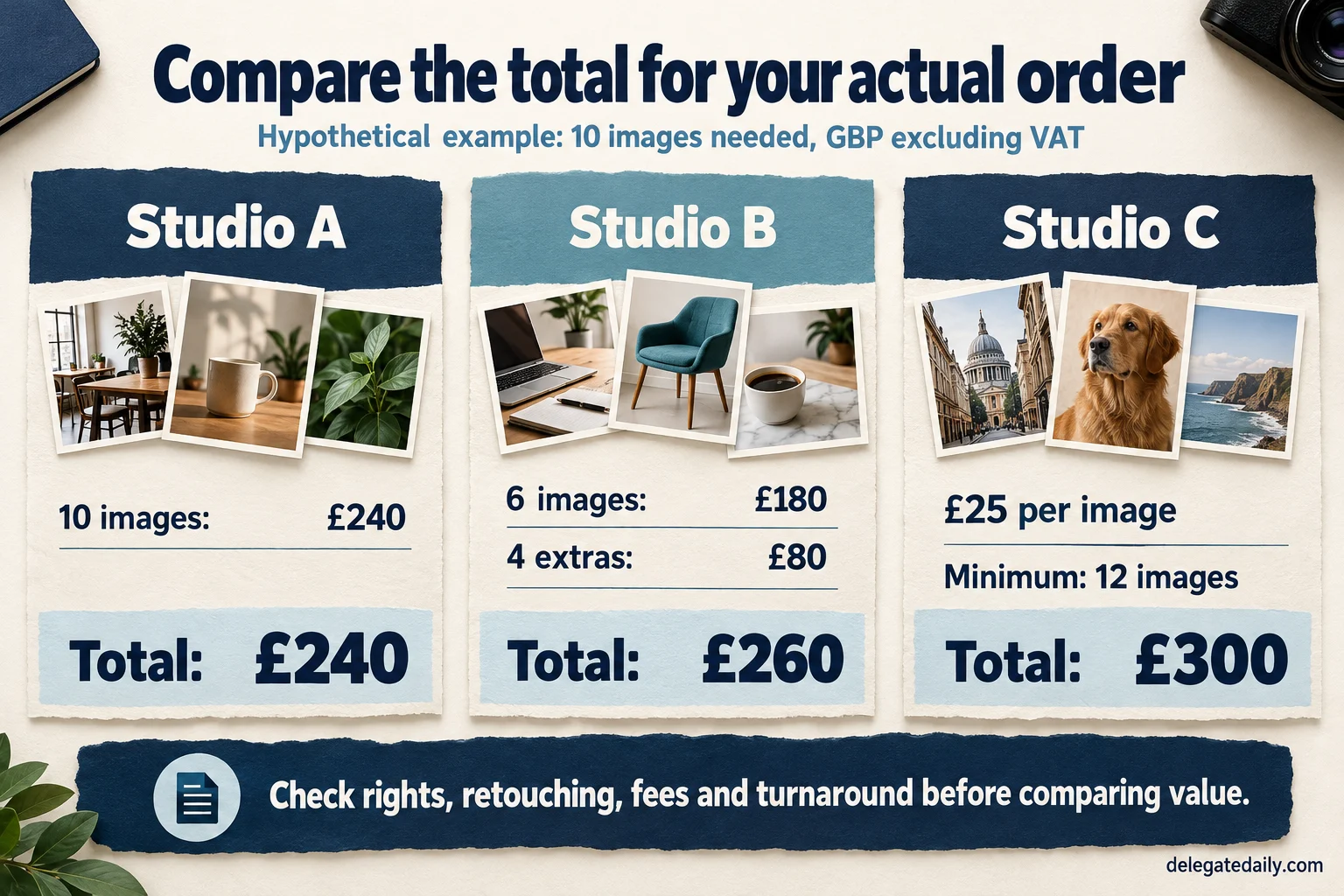
In the hypothetical, all three studios state their prices in GBP excluding VAT, and the buyer needs ten delivered images.
Studio A charges £240 for ten delivered edited images. That is £240 divided by 10, so £24 per image.
Studio B charges £180 for six images, with additional images at £20 each. Ten images means four extras. The extras cost 4 × £20 = £80. The total is £180 + £80 = £260, which is £26 per image.
Studio C charges £25 per image with a minimum order of twelve. The minimum spend is 12 × £25 = £300. That is £25 per delivered image across twelve images, but the buyer only needs ten, so the cost per needed image is £300 divided by 10, which is £30.
That £30 figure needs careful handling. Studio C does not advertise £30 per image and it would be wrong to present it as their rate. It is a derived figure describing what a ten-image buyer would pay under their minimum, and the sheet should label it as derived, with the arithmetic shown.
Before anyone says a word about who is cheapest, the following must be checked for all three: usage rights, retouching depth, background type and whether multiple backgrounds cost extra, product shipping or courier handling, turnaround time, any setup or styling fee, and any minimum commitment or contract term.
If usage rights are not stated, the correct entry is unknown, not included. A package that is silent on rights may be generous, restrictive or simply unconsidered, and guessing turns a gap into a fabrication.

Verify claims instead of collecting them
Source order matters. Official pricing pages, published terms and the business's own help or FAQ content come first. Everything else is secondary and belongs in a separate section of the sheet, clearly marked.
Capture the exact relevant sentence, not a paraphrase. Record the URL, the page section, and the date the page was checked. Where screenshots are permitted, use small relevant extracts for internal verification only, not wholesale republication.
When two sources conflict, leave the conflict visible. If the pricing page says £180 and a landing page says £150 with a promotional banner, the sheet records both rows, marks the status as conflicting, and raises a question for you. Silently averaging them destroys the only information that mattered.
Treat search snippets as leads, never evidence. A snippet can be outdated, truncated or pulled from a page that has since changed, so the VA opens the page and quotes from it.
"Not found" is not "not offered". The sheet should say which pages were checked and when, so the gap is recorded as a limit of the search rather than a property of the competitor.
Keep commentary factual and neutral. Record what a company publishes. Do not write characterisations of a named business that you could not evidence from its own pages.
Where AI helps and where it quietly hurts
AI tools are useful at specific points in this workflow and dangerous at others.
They are genuinely helpful for proposing candidate competitors to investigate, restructuring rows the VA has already collected, flagging inconsistent units or missing fields across a sheet, and drafting a summary from evidence you supply.
They are not a source. OpenAI's own help documentation on whether ChatGPT tells the truth states that it can produce incorrect facts and fabricated citations, and that important information should be verified with reliable sources. A plausible-looking citation is not verification, and neither is a confident tone.
So the rule is simple. Every factual output must link back to a row in the sheet, and a human must open the source and confirm the exact claim, the market, the date and the plan it applies to.
Keep client data out of AI tools unless you have approved it under appropriate settings. Public competitor pages are one thing, your customer list is another.
Here is a prompt that works only from supplied evidence:
"You will receive rows of competitor evidence. Each row contains competitor, claim, observed wording, source URL, page section, checked date, market and currency, billing and quantity. Use only these rows. Do not add facts, prices or companies from your own knowledge. Output three separate sections: Observed facts, each with the competitor name and row reference. Interpretations, each labelled as interpretation and linked to the rows it rests on. Hypotheses to test, each written as a question. Then list Unknowns: any field that is missing, unclear or conflicting. If a comparison requires information not present in the rows, write 'unknown - evidence not supplied' rather than estimating. Do not resolve conflicting rows; list them as conflicts with a question for the owner."
Keep the work inside safe boundaries
Some boundaries should be written into the brief rather than assumed.
Public sources only. No impersonation of a prospective customer, no fake trial signups, no contacting competitors for quotes, and no bypassing paywalls, logins or other access controls.
No automated scraping and no purchase of paid research tools without your written approval. If the VA thinks a paid source would answer something important, they propose it and you decide.
Respect the terms of the sites being read, use screenshots only as small internal extracts where permitted, and never republish someone else's content as your own material.

Accept the report and decide one next test
Acceptance is a checklist, not a feeling.
Check that every row has a source URL, page section and checked date, and that status values are used consistently. Open three rows at random, including at least one price row, and confirm the quoted wording appears where the sheet says it does.
Check that derived figures show their arithmetic, that unknowns are recorded as unknowns, and that the memo's claims each point to rows.
In the hypothetical, the memo might conclude that fixed packages do appear among the studios checked, that inclusions are described inconsistently, and that usage rights are an unknown to resolve for at least one of them. The example says nothing about how often rights go unstated in the wider market. On the illustrative numbers, a ten-image buyer would pay £240, £260 or £300 depending on the studio, with the last figure driven by a minimum order rather than a higher advertised rate.
The tempting response is to publish £229 and undercut everyone. That would be a decision made from the wrong evidence, because prices tell you what is advertised, not what sells or what is profitable.
A better next step is narrow. The owner checks their own cost per edited image and realistic weekly capacity, then speaks to five or six actual prospects about a package with explicit deliverables, stated usage rights and a named turnaround, and only then decides whether to publish it and at what price.
That is one test, with a date and an owner. If it works, the research process that produced it becomes worth turning into a repeatable process you can rerun each quarter without rewriting the brief.
The copy-paste brief
Paste this into your message to the provider and fill the brackets. You can also download the editable competitor research brief.
COMPETITOR EVIDENCE BRIEF

DECISION THIS SUPPORTS
I am deciding whether to [decision]. I will decide by [date].

BUYER AND REGION
Buyer: [who buys this]. Region: [country/area]. Use case: [specific job].

IN SCOPE
Published price, inclusions, usage rights, turnaround, minimum order,
revisions, extras, [add fields].

OUT OF SCOPE
Social following, branding, funding, staff, SEO rankings, [add exclusions].

COMPETITORS (proposed; I approve the final list)
1. [name] - included because [same buyer/problem/region/use case]
2. [name] - included because [reason]
3. [name] - included because [reason]
4. [name] - included because [reason]
5. [alternative/substitute] - included because buyers may choose this instead
Considered and excluded: [name] - [reason]

SAMPLE ROW FIRST
Complete ONE row for ONE competitor and send it before doing anything else.
Wait for my written approval.

EVIDENCE LOG FIELDS (one fact per row)
Competitor | Claim/field | Observed wording or value (exact quote) |
Source URL | Page section | Checked date | Market and currency |
Billing and quantity | Status (confirmed/unclear/not found/conflicting) |
Interpretation | Missing information
A separate summary tab may use one competitor per row, built only from
rows in the log.

SOURCE RULES
Official pricing, terms and help pages first. Secondary sources in a
separate tab, clearly labelled. Quote the exact relevant sentence.
Search snippets are leads, not evidence: open the page.
Five blogs repeating one source is one source.
"Not found" means pages checked and date, not "not offered".
Leave conflicts and promotions unresolved with a question for me.
No characterisation of named businesses beyond what they publish.

PRICE BASIS
All prices in [currency], state whether tax is included, converted to
[per unit / per package of X]. Show the arithmetic for any derived figure
and label it derived. Do not call anything cheapest until usage rights,
retouching, backgrounds, shipping, turnaround, setup fees and minimum
commitment are checked. If a field is not stated, record unknown.

ALLOWED ACTIONS
Public pages only. No impersonation, fake trials, competitor contact,
bypassing logins or paywalls, scraping, or buying paid tools without my
written approval. No client data in AI tools without my approval.

FEE AND TIME CAP
Estimate hours against this brief. Agreed cap: [hours/fee].
Stop at the cap and send progress plus outstanding items.

IF PRICING IS NOT PUBLISHED
Record "not published", list pages checked and the date, and continue
with the rest of the scope.

PAUSE AND MESSAGE ME IF
Sources conflict materially, the list or scope needs changing, the cap is
reached, or anything would require non-public access or an action not
listed above.

ACCEPTANCE CRITERIA
Every row has URL, page section and checked date. Quotes match the pages.
Unknowns recorded as unknowns. Derived figures show arithmetic.
Memo claims reference specific rows.

DELIVERABLES
1. The evidence log.
2. A one-page decision memo with three sections: observed facts,
   interpretations, open questions for me.

OWNER APPROVAL
Sample row approved by [name] on [date]. Final sheet approved on [date].
Send the brief, approve the sample row, and give yourself a date to read the memo. The project is complete when every claim is traceable to a source, the memo says something meaningful about your decision, and you can either make that decision or name precisely which evidence is still missing. It may confirm what you already thought, and that is a legitimate result.