
You have a job in your business that keeps coming back.
The inbox needs clearing. Customers need replies. Product listings need updating. Someone needs to turn a pile of notes into a usable spreadsheet. You know a virtual assistant could take some of it away, but the hiring part feels like another job you do not have time for.
So you search for Filipino virtual assistants, find OnlineJobs.ph, and see the attractive part immediately. A large focused pool. Direct contact. A low platform fee compared with an agency.
Then the awkward questions arrive.
Will you actually find good people, or just a lot of profiles? Is Pro enough? What does Premium really add? How much work remains after you join? And once your time, the worker's pay and the risk of a bad hire are included, is it still cheaper than paying an agency?
My early answer is positive, with one condition: OnlineJobs.ph is a good purchase when you want direct access and control, and you are prepared to make the hiring decisions yourself. It removes a difficult sourcing bottleneck. It does not remove the need for judgement, screening, onboarding or management.
That distinction decides whether the platform feels like a bargain or like another tab you never get around to using.
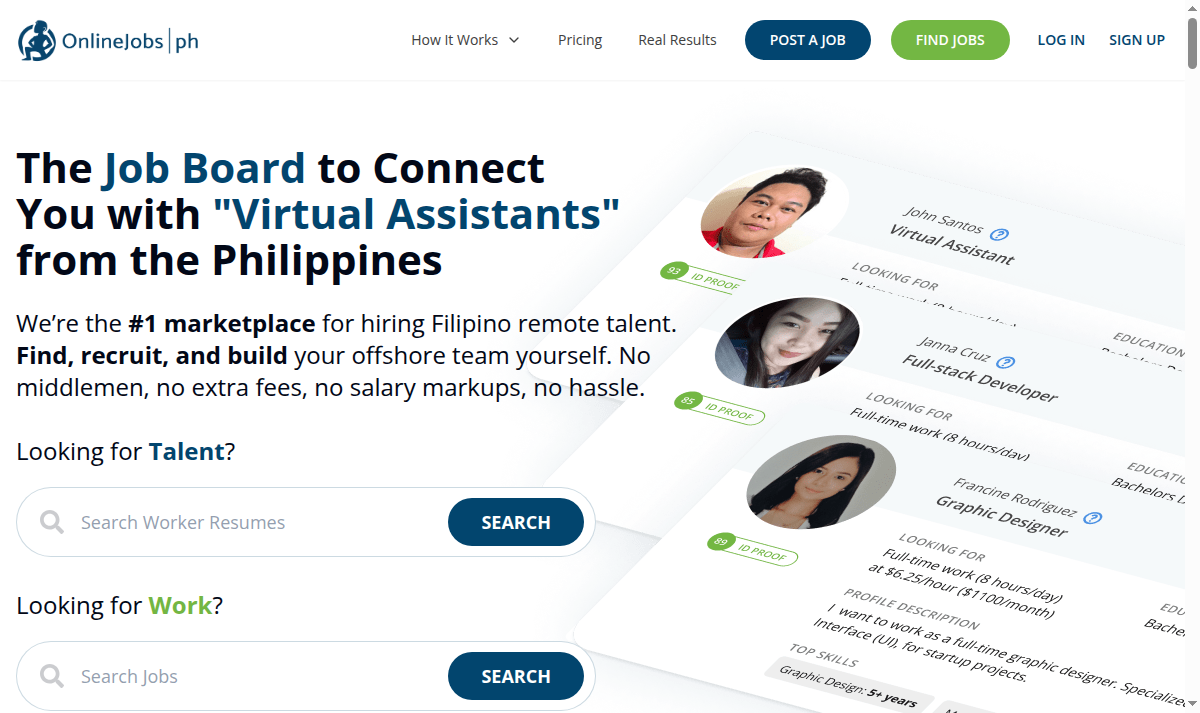
Screenshot 1: The public OnlineJobs.ph homepage presents a direct connection between employers and Filipino remote talent.
If you want to inspect the live employer options, check OnlineJobs.ph here.
The buyer decision is bigger than the membership fee
A cheap hiring platform can still be expensive if it leaves you with a badly defined role, fifty weak applications and no reliable way to judge them.
That is the part many OnlineJobs.ph reviews skip. They list the number of profiles, job posts and plan features, then quietly treat access to candidates as if it were the same thing as a successful hire.
It is not.
Finding people and choosing the right person are separate jobs. OnlineJobs.ph is built to help with the first one. It gives you a place to search, advertise a role, contact workers and start a direct relationship. The second job remains yours.
That is still a strong proposition. If you are spending evenings looking for someone suitable, a focused Filipino talent pool can save time before the interview stage even begins. You are not paying an agency to put a person between you and the worker. You can decide what the role is, what evidence matters and who gets an offer.
The trade is responsibility. You write the brief. You judge the replies. You decide how much to pay. You check practical ability. You control access to your systems. You train the person after hiring.
OnlineJobs.ph is attractive because it gives a small business owner more control without requiring a large recruitment budget. It is unattractive if what you really want is a managed team that arrives already selected, supervised and replaceable.
My verdict before we get into the detail
OnlineJobs.ph is worth testing if all of these statements sound true:
- You want to recruit directly rather than buy a managed VA service.
- You have a specific role in mind, even if it is a small first role.
- You can spend time reviewing applications and interviewing people.
- You are willing to use a practical test before giving someone important access.
- You want Filipino remote talent specifically, rather than a general global freelance marketplace.
For many small businesses, Pro is the sensible paid starting point. It is listed at $69 per month or $299 per year, gives you three job posts, up to 200 applications per post, contact with up to 75 workers per month, instant approval and worker reviews.
Premium is more appropriate if you recruit often, need up to ten job posts, expect to contact a much larger shortlist, or place real value on background data checks, worker mentoring, AI and Smart Shortlist features, One VA Away access, contracts and documents. It is listed at $99 per month or $349 per year.
Free is useful for investigating the pool and seeing whether the platform looks relevant to your role. It is not a complete free hiring process. The published plan information says Free allows up to three job posts and up to 15 applications per job, with a two-day approval period. The pricing FAQ says Free users cannot see applicant contact information or communicate with applicants until they upgrade.
That is the provisional recommendation. The rest of the decision depends on what you expect OnlineJobs.ph to do after you pay.
Quiet affiliate disclosure
This article contains affiliate links. If you use a link here and later buy an eligible OnlineJobs.ph plan, I may receive a commission at no extra cost to you. I have not used OnlineJobs.ph personally and I am not claiming personal hiring results. The review is based on the public official website and pricing information checked on October 12, 2026, plus an analysis of what those published features mean for an employer.
Prices, limits, guarantee wording, cancellation terms and features can change. Check the live official pricing and account terms before purchase.
What OnlineJobs.ph changes in the hiring process
Imagine two owners with the same problem.
Owner A needs one reliable inbox assistant. The work is repeatable. The owner can explain the response standards, check a small sample of written work and spend a few hours choosing someone.
Owner B needs five people, a team leader, payroll handling, replacement cover and someone else to supervise daily performance. The owner is already too busy to interview properly.
OnlineJobs.ph may be a strong fit for Owner A. Owner B is asking for a managed service, even if they describe it as a job-board problem.
The platform changes the first part of the process in useful ways. OnlineJobs.ph says employers can search more than 5,000,000 Filipino profiles. You can post a job and wait for applications, or search profiles and contact people directly. You can also use its AI matching features to help prioritise candidates.
That gives you two routes into the same decision:
- Describe the role and let relevant applicants come to you.
- Search for people whose background already looks close to what you need.
A job post is useful when you can explain the work clearly and want to see how applicants respond to your instructions. Profile search is useful when you already know the skills, tools or experience you need and want to investigate people directly.
You can combine them. A sensible example would be posting a customer-support role, reviewing the first applications, then searching the directory for candidates who have handled similar queues or software.
The platform also supports communication through the site, email, video interviews or chat, according to its public information. That matters because a writing-heavy role needs different evidence from a customer-support role or a design role.
The result is a more direct hiring process. You are not waiting for an agency to decide which person it wants to put forward. You can compare a broader group against your own requirements.
That freedom is useful. It is also where inexperienced employers get into trouble.
What the platform does not solve
A database cannot turn a vague role into a good job.
If your advert says you need someone who can handle admin, social media, customer service, research, design and whatever else comes up, you may get plenty of replies. You will not necessarily get useful evidence about any one skill. The broad wording makes it easier for both sides to misunderstand the arrangement.
OnlineJobs.ph does not choose the worker for you. It does not promise that an applicant will be a good fit. Its AI matching can help with prioritisation, but a ranking is not proof of competence. A profile can be polished and still tell you very little about how someone thinks under pressure.
The employer still has to:
- Define the work and expected output.
- Review applications and profiles.
- Interview candidates.
- Decide the pay and working arrangement.
- Check practical ability.
- Set up accounts, permissions and communication rules.
- Train and manage the worker.
This is not a criticism of the platform. It is the business model. OnlineJobs.ph describes itself as a platform, not a managed agency. The employer hires directly and remains responsible for the working relationship.
The distinction matters for your budget. The membership does not include the worker's salary. It also does not make your time free. You need to allow for the time spent writing the role, checking applications, interviewing, testing, onboarding and giving feedback.
An owner who understands that can use the direct model well. An owner who expects the subscription to deliver a finished employee may feel disappointed even if the platform performs exactly as described.
Why direct access can beat an agency
Agencies solve a different problem.
A managed VA provider may handle more of the selection, supervision, payroll or replacement process. That can be worth paying for when your own time is scarce or when you need a team structure rather than one direct hire.
The cost is usually less control over the individual relationship and a higher overall service price. The agency has to be paid for its work, and the arrangement may include a margin or management fee that is not part of a direct job-board subscription.
OnlineJobs.ph says there are no middlemen, extra fees or salary markups. The worker's pay is negotiated between the employer and worker. That leaves more decisions with you. You can agree the role, rate, hours, availability and communication rules directly rather than accepting a fixed package.
Consider a labelled example. You run a small ecommerce shop and need one person to update product listings, check stock information and answer routine customer messages. You already know the software and can provide examples of acceptable work. You might prefer to find the person yourself, run a short paid test and train them into your process.
An agency could still help, but it may give you more service than you need. OnlineJobs.ph lets you buy access to the hiring market and keep the rest of the relationship in your hands.
Now change the example. You need a support desk that covers several shifts, includes a manager and needs replacement cover when someone leaves. You have no time to screen candidates and do not want to manage daily performance. Direct access is no longer the main need. Management is.
That is where an agency or managed provider may make more sense, even though it costs more.
The platform is not automatically cheaper in every situation. It is cheaper in the specific sense that you are not paying a staffing intermediary to do work you are willing and able to do yourself.
Screenshot 3: The public homepage includes employer testimonials and company references. These are vendor-published examples, so they provide context rather than independent proof of a typical result.
How OnlineJobs.ph pricing fits real buying situations
The most useful way to read OnlineJobs.ph pricing is to start with your hiring situation, not the feature list.
Use Free when you are still deciding whether the pool is relevant
Free makes sense if you have not yet decided whether OnlineJobs.ph has candidates in the category you need. You can post up to three jobs and receive up to 15 applications per job under the current published information. The two-day approval period gives you a slower start than the paid plans.
It is a reasonable research step for an owner who is still asking, "Will I find people with the kind of experience I need?"
The catch is that the free account does not let you complete the important conversation stage. The published FAQ says you can see job applications, but you cannot see applicant contact information or communicate with applicants until you upgrade.
So Free can answer whether the top of the funnel looks promising. It cannot answer whether the best-looking applicants communicate well, complete a test or fit your working style.
Do not stay on Free expecting to run a full hiring campaign without paying. That is not what the plan is designed to do.
Choose Pro when you have a defined role and a manageable shortlist
Pro is listed at $69 per month or $299 per year. It includes three job posts, up to 200 applications per post, contact with up to 75 workers per month, instant approval and worker reviews.
The practical change from Free is large. You have far more application capacity, can contact a meaningful shortlist and do not have the same approval delay. If you are hiring one to three roles and expect to speak with a few dozen promising people, Pro is probably the sensible starting point.
The monthly plan is easier to justify for a single recruitment campaign. The annual figure is much lower than twelve monthly payments, but do not buy a year simply because the arithmetic looks good. Ask whether you will recruit often enough to use the access. A low annual fee is still wasted money if you stop after one job post.
Pro suits an owner who says, "I know the work I need done. I want to speak to candidates myself and I do not need a large recruitment operation."
Choose Premium when capacity or extra screening matters
Premium is listed at $99 per month or $349 per year. It includes up to ten job posts, up to 200 applications per post and contact with up to 500 workers per month. The published feature list also includes worker reviews, background data checks, worker mentoring, AI and Smart Shortlist features, One VA Away access, and contracts and documents.
The extra contact allowance is the obvious reason to upgrade. Pro gives you contact with up to 75 workers per month. Premium raises that to 500. If you are recruiting for several roles or searching a narrow specialist category, that extra room may matter.
The supporting features may matter more for an employer who wants more help around the process. Background data checks can add another input to screening. Mentoring, shortlist tools and documents may reduce some of the friction around moving from a profile to a working arrangement.
They do not remove the need for an interview or a practical test. Treat them as additional evidence and process support.
Premium suits an owner who says, "I recruit repeatedly, I need to contact a lot of people, and the extra checks and documents are useful enough to pay for."
OnlineJobs.ph Pro vs Premium in one decision
Choose Pro when you have a small number of defined roles, a manageable shortlist and no clear need for the Premium-only features.
Choose Premium when you are recruiting repeatedly, need up to ten job posts, expect to contact more than 75 workers in a month, or value the published background, mentoring, shortlist and document features.
The monthly difference is $30. The annual difference is $50. That narrow annual gap makes Premium worth considering if you already know you need its capacity. It does not make Premium the automatic choice for a first-time owner hiring one inbox assistant.
The current published information says a Pro subscriber can upgrade to Premium and pay the prorated difference. It also describes moving from monthly to annual with the last monthly payment counted toward the annual option. Check the live terms before relying on those details.
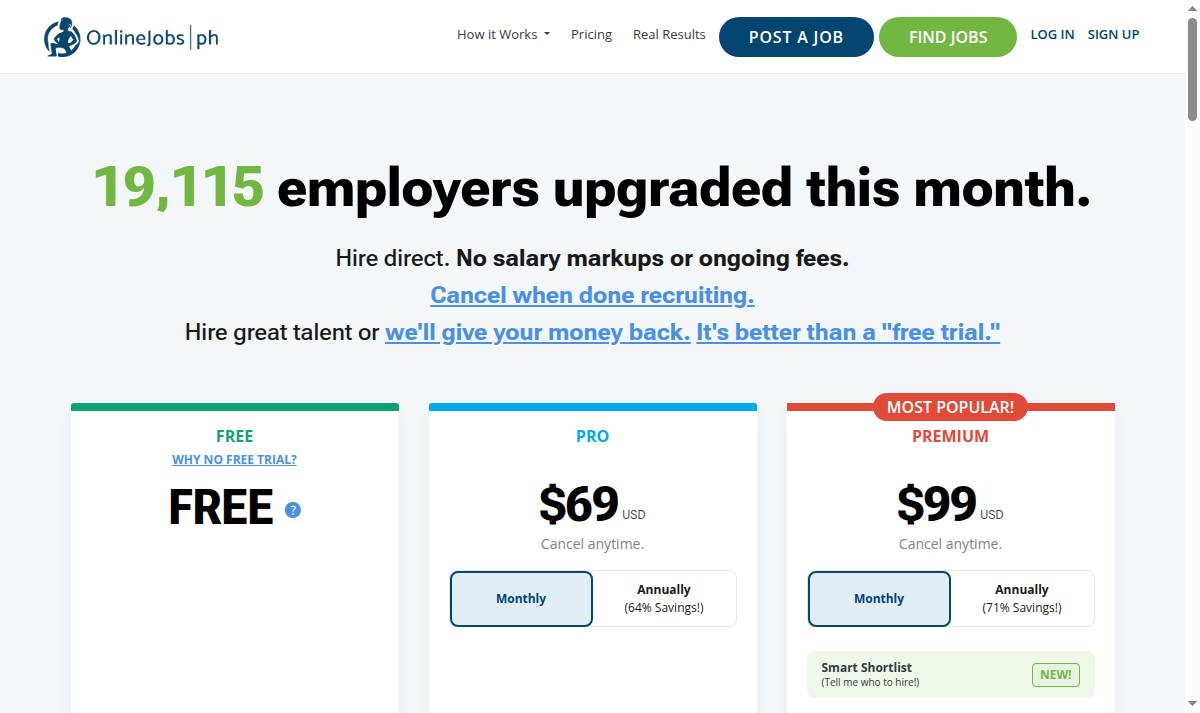
Screenshot 2: Check the live pricing page for current plan limits, cancellation wording and guarantee terms before subscribing.
The first-hire workflow, including where people make mistakes
The subscription decision is only half the purchase. Your first hire will be shaped more by the process you create than by the plan name.
Start with the work that keeps returning
Do not start with a title such as "general VA". Start with the work.
Write down the tasks you repeat every week. Put them in the order they happen. Note which tasks need judgement and which follow a clear pattern. Mark the work that requires customer contact, access to money, personal data or public publishing.
A useful first role might handle routine inbox sorting, calendar updates and customer follow-up. Another might maintain a product catalogue. A third might turn approved recordings into short clips. Those are different roles even if you call all of them virtual assistant work.
If you combine unrelated jobs into one advert, you make screening harder and increase the chance that the successful candidate is good at only one part of the role.
Write a scorecard before you read profiles
A scorecard is a short list of things the person must be able to do. Add the tools involved, the expected weekly output and what acceptable work looks like.
For an inbox assistant, the scorecard might include:
- Sort messages into the right categories.
- Draft replies in the supplied tone.
- Flag urgent or unusual issues instead of guessing.
- Produce a short daily report.
- Follow permission rules around customer data.
This is an example, not a required template. The point is to create a standard before a friendly application influences your judgement.
Write a post that filters people in and out
Explain the business context, the actual first priorities, the schedule, the required overlap and the tools involved. Ask for one or two relevant examples. Give applicants a simple instruction that shows whether they read the post.
Do not use tricks as a substitute for clarity. A chosen opening word can reveal who follows instructions, but it cannot tell you who will perform well.
Be honest about the arrangement. OnlineJobs.ph says employers can hire full-time, part-time, per project, hourly, salaried or other arrangements that suit the work. Put the expected hours, availability, pay terms, review process and communication rules in writing.
Review evidence instead of enthusiasm
A long message saying "I am hardworking and can do anything" is not useful evidence on its own. A shorter reply that answers your question, points to relevant work and explains how the applicant would approach the first task gives you more to work with.
Look for a match between the person's claimed experience and the work you actually need. Someone who has managed an ecommerce catalogue should be able to explain product data, image standards or stock issues. Someone applying for customer support should be able to describe how they would handle an upset customer and record the outcome.
Profiles are leads. They are not guarantees.
Use a small paid test
A practical test should resemble the work and be small enough to complete fairly. Pay for work that creates real value for the business. Do not send every applicant a large unpaid project.
For a writing role, you might ask for a short rewrite of a customer message. For an admin role, you might provide a deliberately messy list and ask the candidate to organise it. For customer support, you might ask for a response to a sample complaint.
The test can show attention to detail, ability to follow instructions and communication quality. It cannot predict every part of a future working relationship, so use it alongside an interview.
Interview for judgement, not just confidence
Ask what the candidate would do in situations they will actually face.
What would you do if two customers needed urgent help at the same time? What would you check before publishing this product listing? When would you stop and ask for clarification? How would you report a task that could not be completed on time?
The answers tell you whether the person notices risk, understands priorities and knows when not to guess. A confident interview is pleasant. Good judgement is more useful.
Give the first week a shape
A new worker should not receive every password, every document and a vague instruction to get started.
Give access only to the systems needed for the first tasks. Provide examples of good work. Set a short list of priorities. Agree how blockers are reported. Schedule an early review rather than waiting a month to discover that your instructions meant different things to each of you.
Save recurring instructions in a shared document. Include naming rules, customer tone, escalation points and examples of common mistakes. The document becomes more useful as real questions appear.
OnlineJobs.ph can help you find the person. Your first-week system determines whether that person can become useful.
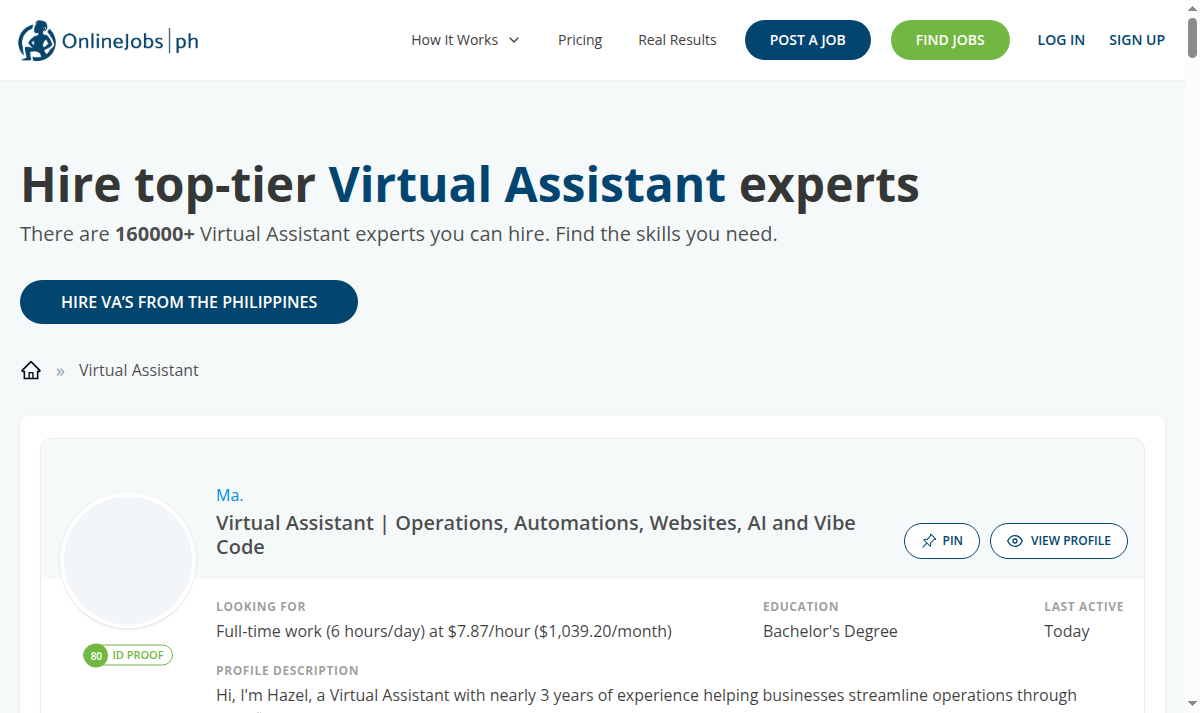
Screenshot 4: The public directory supports direct investigation of candidate profiles instead of relying only on incoming job applications.
How to recognise a promising candidate without pretending profiles prove quality
There is no reliable shortcut from a profile to a good hire.
You are looking for enough evidence to justify the next step, not certainty before you have spoken to the person.
Start with relevance. Has the candidate done work close to the role? If the job involves Shopify, customer tickets, CRM updates or short-form editing, look for specific examples rather than a long list of software names.
Read the application against the instructions. Did the person answer the question you asked? Did they explain their experience in a way you can understand? Did they notice a detail in the role description?
Check the work sample where the role allows it. A portfolio can show presentation quality, but it may not prove that the person did all the work or can repeat it under your direction. Ask a sensible question about one example.
Pay attention to communication without turning accent or personality into a quality test. OnlineJobs.ph's homepage describes English as one of the Philippines' two official languages and presents communication as one reason employers recruit there. Applicants will still vary in writing style, clarity and experience. Test the communication the job needs.
If the person will write to customers, assess customer writing. If they will report to you, ask for a short update based on a sample task. If they will use AI, ask what they check before passing AI-assisted work to a customer or publishing it.
Worker reviews can add context where available. They do not replace a current conversation about your role. A review was written for someone else's working arrangement, with someone else's expectations.
Availability needs care too. Agree the hours and overlap you actually need. Do not treat a Filipino location as permission to expect a person to answer at all hours. A clear schedule is better for both sides.
The real cost after OnlineJobs.ph pricing
The membership is visible. The rest of the cost is easy to ignore because it arrives as your own time.
A realistic decision includes:
- The OnlineJobs.ph subscription.
- The worker's agreed pay.
- Time spent writing the role.
- Application review and shortlisting.
- Interview time.
- Paid testing.
- Onboarding and training.
- Software, equipment or access costs where applicable.
- Payment or transfer costs.
- Ongoing management and feedback.
The platform does not publish a single worker salary that can be used for every role, and this review should not invent one. Pay depends on the work, hours, experience and arrangement you agree with the worker.
The same applies to your time. There is no honest universal number for how many hours a hire will take. A clear repeatable role may be straightforward to screen. A role involving customer judgement, sensitive information or several software systems needs more care.
This is why the agency comparison has to include your time. If you are able to run the process and want direct control, the platform fee may be a small part of the overall decision. If you cannot make time for screening and onboarding, a low subscription price does not solve the bottleneck.
For a single campaign, monthly Pro may be easier to justify than an annual plan, even though $299 is much lower than twelve monthly payments of $69. For repeated recruiting, annual access may make more sense. The question is how often you will use it and how much recruiting capacity you need.
Premium at $99 monthly adds $30 over Pro at the monthly rates. The annual prices are $349 for Premium and $299 for Pro, a $50 difference. That can be an easy decision for an active recruiter who needs Premium's contact allowance or features. It is not a reason for a one-role employer to buy a bigger plan on hope.
Start with the role. Then buy the amount of access that supports that role.
Safety, access and scam checks
A legitimate hiring platform can still contain individual applicants who are not suitable for your business. Your process needs its own safety controls.
Keep the first conversation focused on the work. Do not send administrator passwords, payment information, customer lists or private marketing data to prove that you are serious.
Use separate user accounts and limited permissions where the software allows it. Add access in stages. If the first task only needs a content folder, do not also give access to your billing system and customer database.
Agree pay, timing, deliverables and communication in writing. Do not make a large advance payment for work that has not been completed without understanding the arrangement and what happens if the work stops.
Watch for urgency that does not fit the job, requests to move immediately to an unusual payment channel, copied or inconsistent work samples, or refusal to answer reasonable questions. One odd detail may have an innocent explanation. Several together are a reason to pause.
Use strong unique passwords and multi-factor authentication on your own accounts. Keep a simple record of who has access to what. Remove access promptly when a person leaves or the project ends.
Premium's published feature list includes background data checks. That can provide another screening input, but it is not a complete identity, skill or security guarantee. You still need your own interview, practical test and access controls.
Timeproof and Easypay are part of the OnlineJobs.ph ecosystem. The pricing FAQ says they remain available for free after an employer cancels a subscription. Read the current guidance so you understand what those tools cover and keep your own payment records.
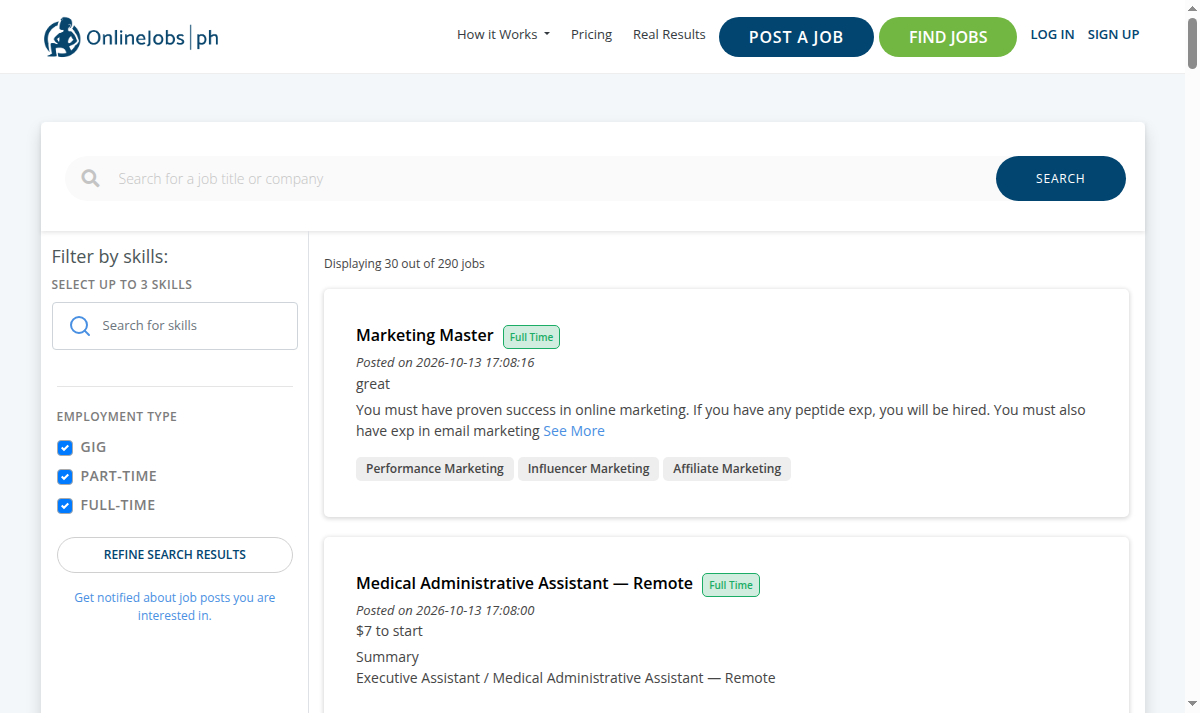
Screenshot 5: A public job-search view helps an employer see the kinds of roles and candidate information available before choosing a plan.
Who should buy, who should use Free first, and who should walk away
Buy OnlineJobs.ph when direct recruiting fits the way you want to run the business.
It is a good match for an owner hiring a first remote team member, especially when the work is repeatable enough to explain and review. It also suits an owner who wants to choose the person directly, recruit Filipino talent specifically and build a longer working relationship rather than order a one-off task.
Use Free first when you are still unsure whether the candidate pool includes people relevant to your role. It lets you inspect the process and applications within its limits. Move to a paid plan when you need to see contact information and communicate with applicants.
Start with Pro when you have a defined role, expect to contact a manageable shortlist and want the lowest paid tier with a usable recruiting workflow.
Choose Premium when you recruit regularly, need up to ten job posts, need contact capacity beyond 75 workers per month, or value the listed background, mentoring, shortlist and document features.
Do not buy a paid plan if you have not decided what the worker will do. Do not buy it if you have no time to review applications or interview properly. Do not buy it if you expect the platform to guarantee a perfect hire, provide local payroll or employment advice, or manage the worker every day.
It may also be the wrong tool for a single short freelance task. A general marketplace may suit a defined project better. An agency may suit an owner who wants recruitment and supervision bundled together. A local service may suit a role requiring physical presence, local licensing or a specific employment structure.
That is not a failure of OnlineJobs.ph. It is a sign that the buyer is asking for a different service.
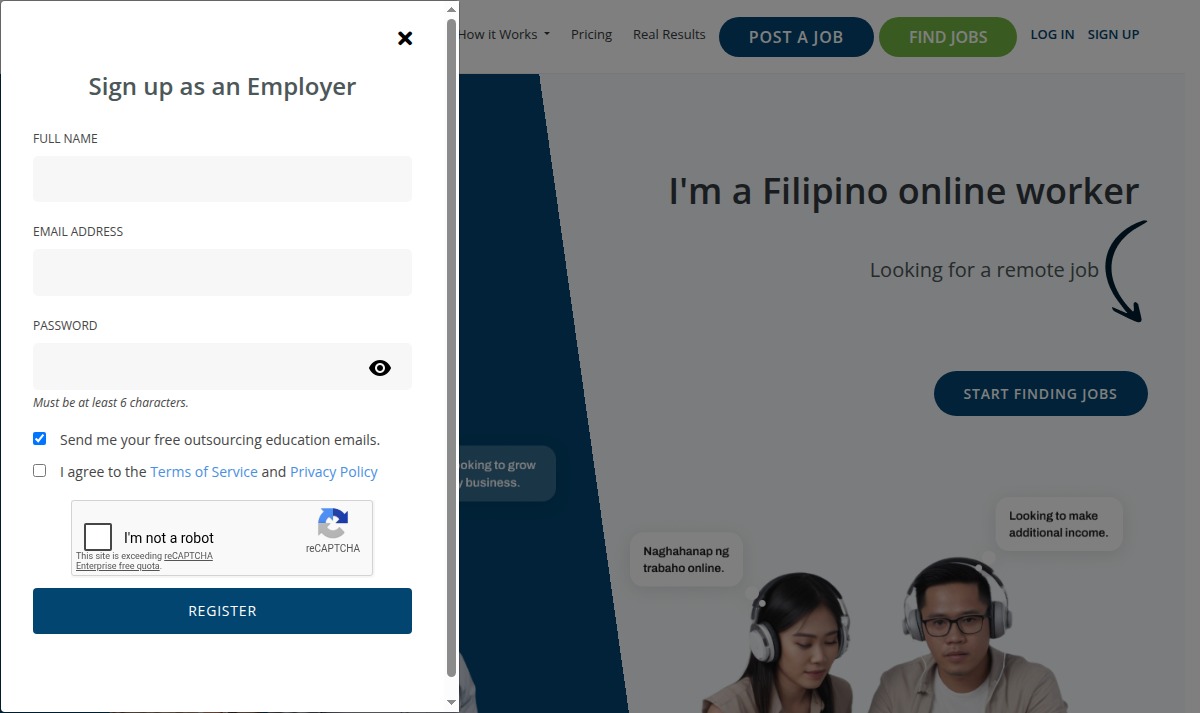
Screenshot 6: The public registration screen is the starting point for an employer who wants to inspect the account process and create a job post.
OnlineJobs.ph alternatives by buyer type
There is no single best OnlineJobs.ph alternative because the hiring problem changes from business to business.
A general freelance marketplace may be better when you need a defined deliverable, a specialist from any country or a platform-managed project workflow. You may prefer bids, ratings and a shorter project relationship.
An agency may be better when you want someone else to shortlist, supervise or replace workers. You pay for that service, but it can be the right trade if your own management time is the scarce resource.
A local recruitment service may be better when the role needs local payroll, local employment handling, physical presence or knowledge of your country's regulations. OnlineJobs.ph is a cross-border remote hiring platform, not a substitute for every local employment service.
A specialist recruitment firm may be better for a senior, confidential or technically difficult role where a standard job post will not give you enough evidence.
Referrals may be better when someone you trust can recommend a person whose work they have already seen. The downside is that your network is limited. OnlineJobs.ph gives you a larger search pool, but you have to create your own evidence through screening.
The direct platform model works best when your real question is, "Can I find relevant Filipino candidates and choose the right one myself?" It is less suitable when the real question is, "Can someone else take over the whole staffing problem?"
Frequently asked questions from a cautious buyer
Is OnlineJobs.ph legitimate?
OnlineJobs.ph is an established public hiring platform focused on Filipino remote talent. Its official website describes profile search, job posting, direct communication, interviews, AI matching, Timeproof and Easypay. That does not mean every applicant is suitable. Treat the platform's legitimacy and an individual candidate's suitability as separate questions.
Is OnlineJobs.ph free for employers?
There is a Free plan. The current published information says it allows up to three job posts and up to 15 applications per job, with a two-day approval period. The pricing FAQ says Free users can see applications but cannot see applicant contact information or communicate with applicants until they upgrade.
How much does OnlineJobs.ph cost?
The current pricing information lists Pro at $69 monthly or $299 annually, and Premium at $99 monthly or $349 annually. Free is available with its stated limits. Prices and terms can change, so check the live official pricing page before subscribing.
What is the difference between OnlineJobs.ph Pro and Premium?
Pro includes three job posts, up to 200 applications per post, contact with up to 75 workers per month, instant approval and worker reviews. Premium includes up to ten job posts, up to 200 applications per post, contact with up to 500 workers per month, worker reviews, background data checks, worker mentoring, AI and Smart Shortlist features, One VA Away access, and contracts and documents.
Is Pro enough for a first hire?
It probably is if you have one to three defined roles, expect to contact a manageable shortlist and do not need the listed Premium features. Pro is the plan I would inspect first for a small employer who has already written the role and is ready to interview.
Is Premium worth it?
Premium is worth considering when you recruit frequently, need up to ten job posts, expect to contact many workers or place meaningful value on its additional checks, mentoring, shortlist and document features. It is probably unnecessary for one narrow hiring campaign with a short shortlist.
Can I cancel OnlineJobs.ph?
The official pricing FAQ says there is no time requirement or contract and that an employer can cancel when finished recruiting. It describes cancellation through the account billing area. Check the current account and billing terms before relying on that wording.
Does OnlineJobs.ph offer a money-back guarantee?
The pricing page presents money-back guarantee language for employers who do not find someone. The eligibility rules and procedure matter, so read the live guarantee wording before subscribing. Do not treat a guarantee as a substitute for writing a clear role and running a proper hiring process.
Does OnlineJobs.ph charge a salary markup?
The platform says it has no middlemen, extra fees or salary markups. The worker's pay is negotiated between the employer and worker. Salary, payment costs and any tools or equipment you provide remain separate from the membership price.
Can I hire a Filipino virtual assistant part-time?
Yes. The homepage says employers can hire full-time, part-time, per project, hourly, salaried or other arrangements that suit the work. Put the hours, availability, pay and expected output in writing before the relationship starts.
Does OnlineJobs.ph employ the worker for me?
No. OnlineJobs.ph describes itself as a platform rather than an agency. The employer hires directly and manages the relationship. You remain responsible for understanding the legal, tax and operational requirements that apply to your arrangement.
Is OnlineJobs.ph better than Upwork or Fiverr?
Not for every buyer. OnlineJobs.ph is focused on direct recruitment of Filipino remote workers and can suit a longer-term team relationship. A general freelance marketplace may be better for a one-off project, a wider international search or a platform-managed gig workflow.
How do I avoid scams when hiring through OnlineJobs.ph?
Write a clear role, check relevant experience, run a small paid test, interview properly, limit permissions and agree pay and deliverables in writing. Do not send sensitive credentials or large sums before the working arrangement is clear. Keep the first access level small and expand it only when the work requires it.
The decision I would make in your position
If you need one reliable remote worker and you are willing to do the choosing, OnlineJobs.ph is worth testing. The focused Filipino pool and direct contact model can remove the hardest early problem, finding enough relevant people to consider.
I would not buy the subscription first and work out the role afterwards. I would write the first job scorecard, decide what evidence a candidate must show, then choose the smallest plan that gives me the contact access needed to run that process.
For many small employers, that means starting with Pro at $69 per month. Free can help you inspect whether the pool looks relevant. Premium at $99 per month makes more sense when you are actively recruiting several roles, need the higher contact allowance or want the extra listed tools.
The value is not the membership fee by itself. The value is the time saved getting to a focused candidate pool, while you keep control of the decision. That is a good trade for an owner who can screen and onboard properly.
It is the wrong trade for an owner who wants someone else to take responsibility for the whole hiring and management process.
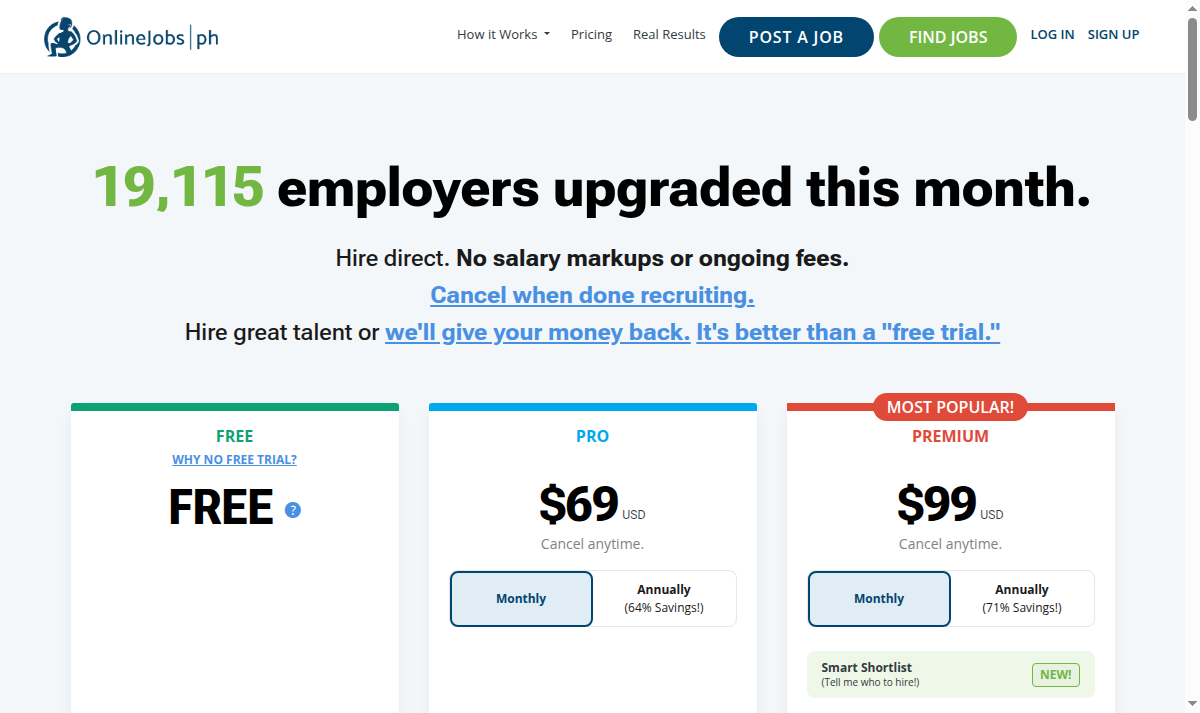
Screenshot 7: Use the official employer route to check current account options, plan terms and the next step for recruitment.
Ready to check the live plans?
If you want direct access to Filipino remote talent and are prepared to run the hiring process, check OnlineJobs.ph and view the current employer options here.
Before you pay, confirm the current price, job-post allowance, worker-contact limit, cancellation wording and guarantee terms. Then compare the plan with the role you actually intend to recruit, not the bigger team you may hire one day.
Sources
[1] OnlineJobs.ph official homepage, checked October 12, 2026. Used for the platform description, 5,000,000+ Filipino profiles, direct hiring model, no middlemen or salary markups, job posting, profile search, AI matching, communication and interview options, role categories, Timeproof and employer-facing claims.
[2] OnlineJobs.ph official pricing page, checked October 12, 2026. Used for plan structure, Free limitations, cancellation language, money-back guarantee language, continued Timeproof and Easypay access, and the published upgrade and billing explanations.
Pricing, feature limits, availability, cancellation rules and guarantee terms can change. Readers should recheck the live official pages before purchase.